Request our guidance on top cybersecurity priorities
We’ll help you evaluate your cybersecurity strengths and vulnerabilities


It's 8:00 on a Monday. Dana, the IT director at a 400-person manufacturer, logs in to her vulnerability scanner and finds 212 open findings. Twelve minutes later she's in her attack surface tool, looking at two new subdomains. Are they the servers the scanner just flagged? She can't tell.
By 8:45 she has logged in to five tools, read five dashboards that score risk five different ways, and opened a spreadsheet to stitch it all together. Nothing has been fixed.
Dana isn't a real person. But if you run IT at a mid-sized company, her Monday probably sounds familiar.
The cyber insurer asked about external vulnerability scanning. A customer questionnaire asked about the attack surface. A breach in the news led to dark web monitoring. Email problems led to a DMARC tool. The board wanted a security score. Each purchase made sense on its own.
The pressure behind those purchases is real. Exploiting a vulnerability is now the most common way into a breach, according to the Verizon 2026 Data Breach Investigations Report. But the problem isn't any single tool. It's the stack.

We priced each of the five tool categories at the cheapest published option we could find. Not a typical deal. The floor. It still comes to $20,006 a year. At the top of the market, the same five categories reach $107,500.
Then there's time. We modeled Dana's week conservatively: five consoles, a few visits a week each, and two hours of routine admin. That's 182 hours a year, or four and a half working weeks spent keeping the tools running. Before anyone fixes anything.
And here's the part that matters most. None of those five tools delivers a penetration test.
Consolidation isn't about fewer logos on an invoice. It's about one view of your perimeter, one list of what matters and more time spent fixing.
That's the model we built LUMA Perimeter around. It brings external vulnerability scanning, attack surface management, dark web monitoring, email health and security scoring together with continuous external penetration testing, validated by our experts. One platform. One contract. Roughly the cost of one annual pen test.
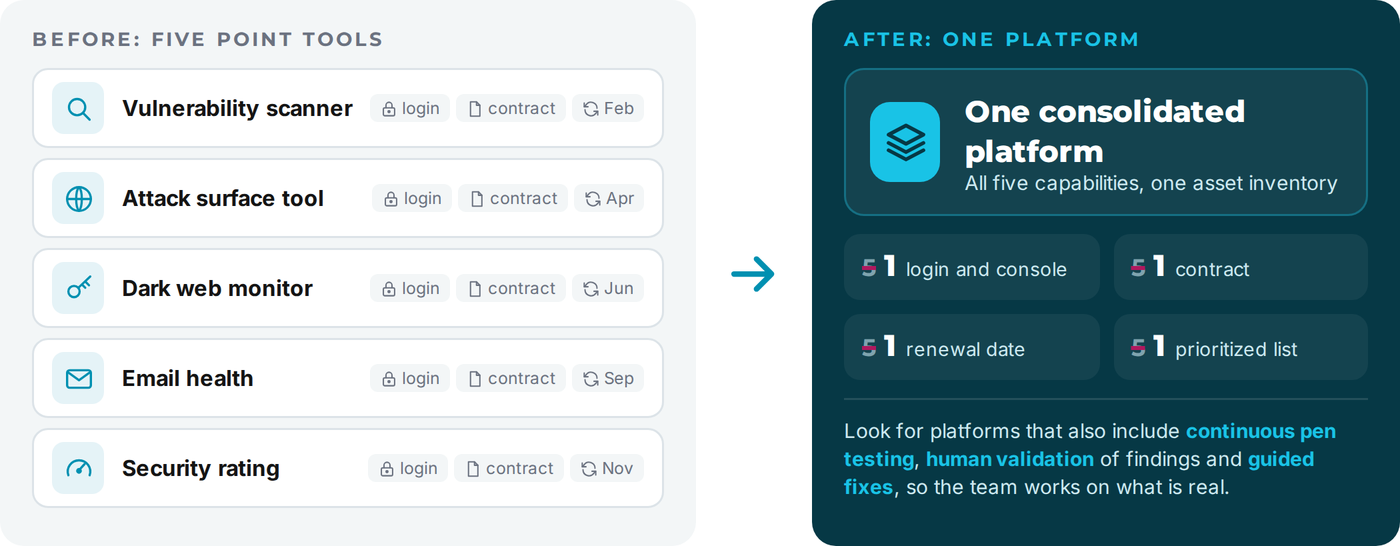
For Dana, Monday morning becomes one login and one prioritized list of validated findings, with the fix attached.
Before your next renewal, add up what you're paying across every tool and every login. Our white paper shows you exactly how. Inside, you'll find:
Download the white paper: The Hidden Cost of a Fragmented Security Stack. Or talk to our team about what your stack is really costing you.