On May 5, Parabellyx took the stage at the inaugural CIS 2026 Pitch Fest in Toronto. Ten minutes. Five judges, three of them sitting CISOs, one a senior venture investor, and one a senior director of procurement at the Government of Canada. Strong field. Tough room.
Test your entire public attack surface. Every time, all the time.
LUMA Perimeter Continuous External Exposure Management and Penetration Testing Platform
LUMA Perimeter allows you to detect any security issues with organization data and services on the internet much faster than adversaries would.
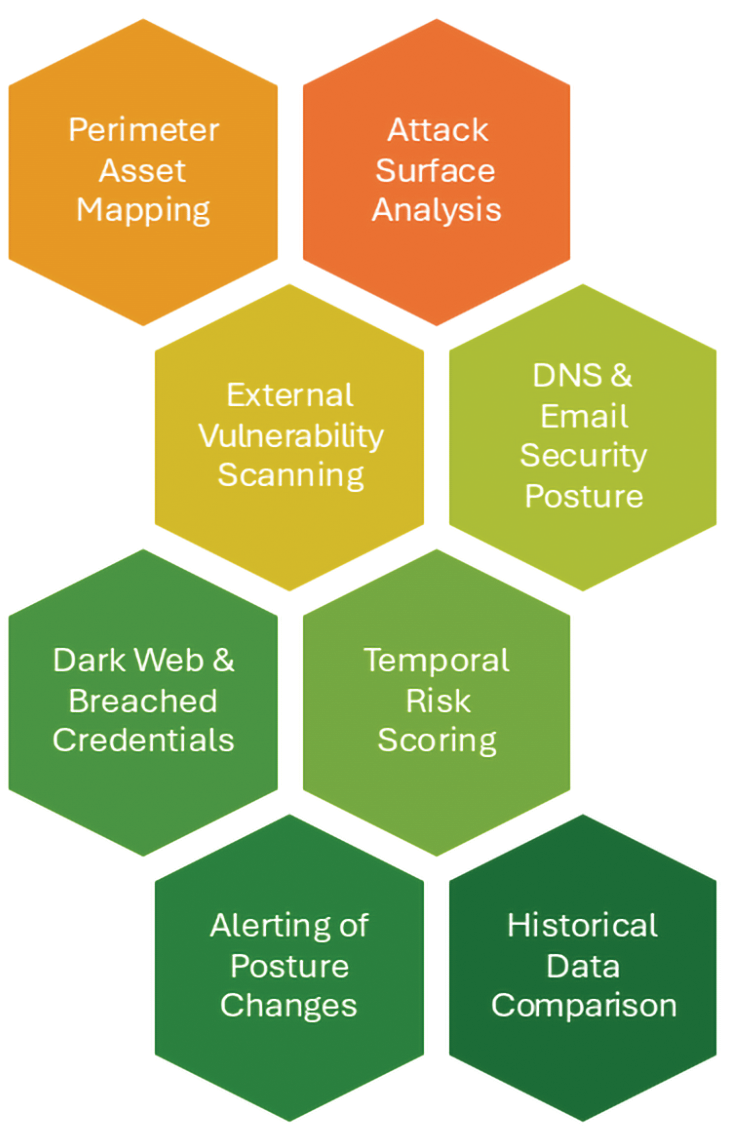
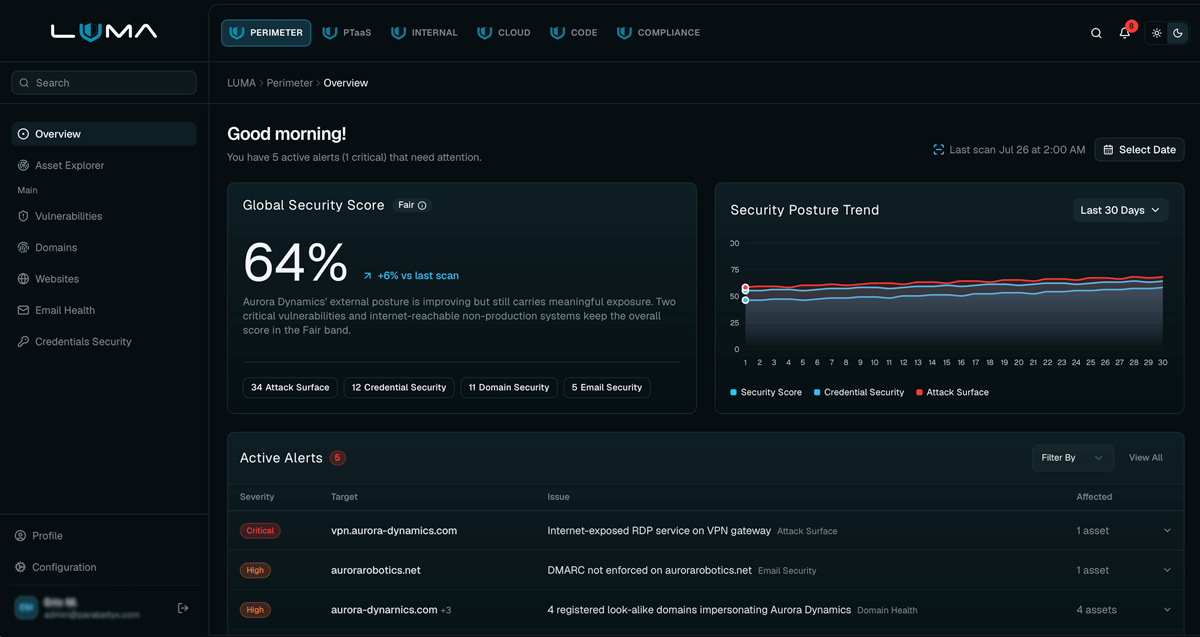
LUMA Security AI platform combines attack surface management and public risk monitoring with active testing and exploitability analysis. You can monitor any changes to the external digital footprint, test all externally exposed services, keep track of public risks from multiple sources, and maintain a regularly updated penetration testing report.
LUMA Perimeter platform allows you to track risks, maintain regulatory compliance and continuously test the security of your publicly exposed assets from a single console.
What separates LUMA Perimeter from an attack surface scanner is what happens after the finding. Every uncertain result is reviewed by one of our testers before it reaches you, and it arrives with a fix advice written for your environment rather than a link to a generic advisory.

The Benefits of LUMA Perimeter
Make security testing a continuous process
Continuously test your externally exposed services against existing and new exploits and attacks. Replace multiple monitoring and testing tools with a single AI platform.
Detect changes in your attack surface
Maintain a complete perimeter asset mapping and detect changes in your externally exposed assets and services as they occur.
Track public data risks
Be aware of breached credentials, typosquatting and clickjacking risks, DNS and email health and security posture.
Make changes with confidence
Ensure that no unwanted services or assets are exposed during the change process. Conduct external penetration testing on the new or changed assets and services immediately.
Maintain trust and compliance
Always walk into an audit, a vendor security review, or an insurance renewal with an up-to-date penetration testing report.
Why LUMA Perimeter?
Track changes to your externally exposed assets, digital footprint and public risks. Replace multiple security tools and cut down security management effort and costs. Conduct daily comprehensive testing and maintain an up-to-date penetration testing report. Get support and guidance on resolving detected security issues.
Heading 1
with a request body that specifies how to map the columns of your import file to the associated CRM properties in HubSpot.... In the request JSON, define the import file details, including mapping the spreadsheet's columns to HubSpot data. Your request JSON should include the following fields:... entry for each column.
Use Cases
Continuously monitor and test the attack surface
Be constantly aware of all changes to your publicly exposed services, both on-premises and in the cloud. Get continuous penetration testing in the context of those changes. Prevent breaches through unsanctioned and insecure external services.
Keep track of public risks
Track targeted malicious activity, including breached credentials, domain impersonations and other signs of imminent attacks. Understand what each of these risk signals means for your organization based on the technologies you use.
Secure change management
Ensure your planned and emergency changes do not expose additional services and data that are not meant for public access.
Consolidate tools, save money
Luma Perimeter is a SaaS platform that combines multiple monitoring and testing solutions. It enables decluttering of security tooling and saves money.
Interested In Our LUMA Perimeter Platform?
We’ll help you detect, test, and fix your external security issues before adversaries become aware of them.
Heading 1
with a request body that specifies how to map the columns of your import file to the associated CRM properties in HubSpot.... In the request JSON, define the import file details, including mapping the spreadsheet's columns to HubSpot data. Your request JSON should include the following fields:... entry for each column.
Recent Insights
Every major security conference in 2026 is running sessions on how to secure AI agents. The conversations are serious, the concerns are legitimate, and the focus is, in large part, pointed at the wrong target.
Cybersecurity testing has evolved dramatically over the past two decades. What started as annual penetration tests has become continuous, automated, and increasingly powered by AI agents themselves. Organizations now deploy intelligent agents to run vulnerability scans, validate configurations,...
Other LUMA Security Platform Modules
LUMA Code
Identify, validate, prioritize, and fix application security issues. LUMA Code gives your developers clear and actionable guidance to reduce code security weaknesses and embrace security-by-design. Reduce the friction between cybersecurity, compliance, and software development.
LUMA Compliance
Bridge risk management and compliance. Enhance trust between technology teams, business stakeholders, and customers through continuous GRC assessment and controls monitoring, for SOC2, ISO 27001, and CMMC using LUMA Compliance.
LUMA Penetration Testing as a Service
Engage our agentic testing workflows and award-winning team of ethical hackers to test your applications, modern infrastructure, AI, and OT. Understand real exposure to cybersecurity risks with in-depth validation of complex security systems. Delivered through the LUMA platform for continuous value.
Request our guidance on top cybersecurity testing priorities
We’ll help you turn your cybersecurity strengths and weaknesses into a strategy.
Heading 1
with a request body that specifies how to map the columns of your import file to the associated CRM properties in HubSpot.... In the request JSON, define the import file details, including mapping the spreadsheet's columns to HubSpot data. Your request JSON should include the following fields:... entry for each column.