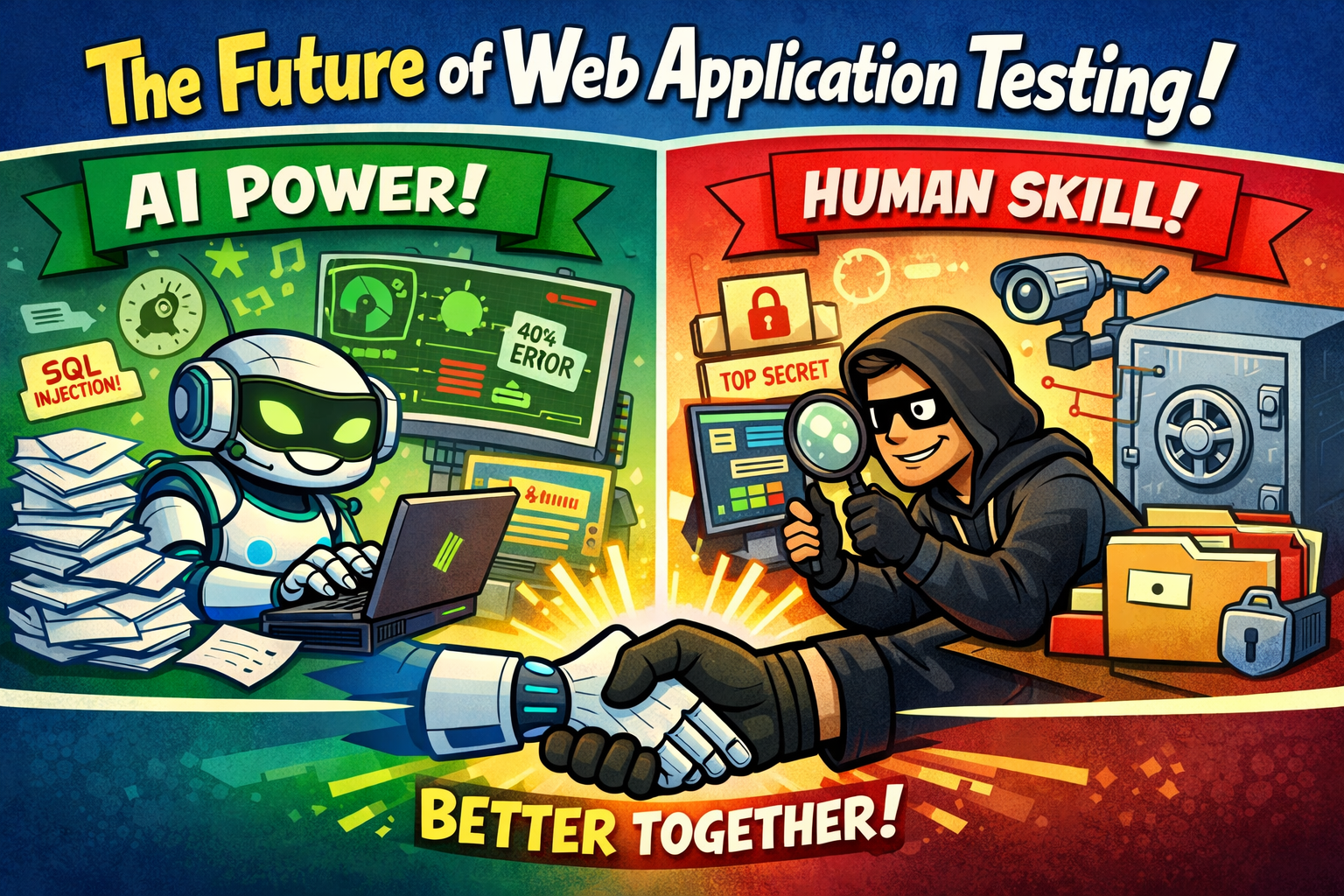
In mid-2025, an AI system called XBOW reached the number one position on HackerOne’s global bug bounty leaderboard, submitting over a thousand validated vulnerabilities. It completed 104 web security challenges in 28 minutes, a task that took a veteran human tester 40 hours. Around the same time, Stanford’s ARTEMIS agent outperformed nine out of ten professional penetration testers in a live enterprise environment. The signal is clear: AI-based web application security testing has arrived.
The instinctive reaction is alarm. If machines find vulnerabilities faster and cheaper, what happens to the humans? I do believe the opposite conclusion is correct. This is not a displacement story. It is a liberation.
Over the past six months, AI tools have demonstrated high accuracy across several OWASP Top 10 categories. Injection flaws, security misconfigurations, vulnerable components, server-side request forgery, and many cryptographic failures are pattern-based by nature. AI can generate thousands of payload variations, test them in parallel, and confirm exploitation with a consistency that no human can match across a large application surface. By my assessment, roughly half of the OWASP Top 10 will be effectively addressed by AI-based testing by the end of this year.
Here is the part the headlines miss: the categories where AI excels are the ones penetration testers find repetitive. Confirming dozens of cross-site scripting instances, cataloguing injections one at a time, verifying patched component versions and cryptographic algorithms strength: these tasks demand thoroughness and patience, not creativity. Talented testers are not at their best performing what amounts to highly skilled data entry.
The other half of the OWASP Top 10 is where human expertise remains irreplaceable. Broken access control requires understanding how specific business roles interact with application workflows. Insecure design means catching flaws that exist not in code but in the architecture of a process. MFA bypasses, exploit chaining, privilege escalation through multi-step workflows: these demand adversarial intuition and deep contextual knowledge. Research shows that roughly 70% of critical web application vulnerabilities are business logic flaws, precisely the category automated tools are least equipped to detect. AI does not understand intent. It cannot reason about what an application is supposed to do, only about what it observably does.
When Garry Kasparov lost to Deep Blue in 1997, many assumed competitive chess was finished. Instead, Kasparov pioneered “advanced chess,” where human players partnered with computer engines. These teams consistently outperformed both unassisted humans and standalone computers. The humans provided strategic intuition and the ability to recognize when the computer’s recommendation was tactically sound but positionally wrong. The computers provided speed, depth, and consistency. Neither was sufficient alone.
Web application penetration testing is reaching its own Kasparov moment. The hybrid model, where AI handles pattern-based, high-volume testing while humans focus on design flaws, business logic, and exploit chaining, is not a compromise. It is an optimization.
For customers, this means faster results, broader coverage, and deeper human expertise focused on the vulnerabilities that carry the highest business risk. For penetration testers, it means the end of the tedious and the beginning of the interesting. The work that remains is the work that attracted most of them to the field in the first place: adversarial puzzle-solving, creative exploitation, and the satisfaction of finding something no tool would have caught.
We are here for you, whichever side of that equation you sit on.